
PHP security updates have been announced to address critical vulnerabilities affecting all supported versions of the programming language. The PHP development team has scheduled the security releases for November 19, 2026, warning developers and system administrators to prepare for immediate upgrades once the patches become available.
This announcement has been met with concern in the entire web development community, considering that PHP runs millions of websites, web apps, content management systems, and server-side technologies.
The PHP security team says that the updates scheduled to come out will patch various security vulnerabilities, with the most severe level being Critical. However, the PHP security team has confirmed that the critical vulnerabilities require non-standard configuration or unusual server setup.
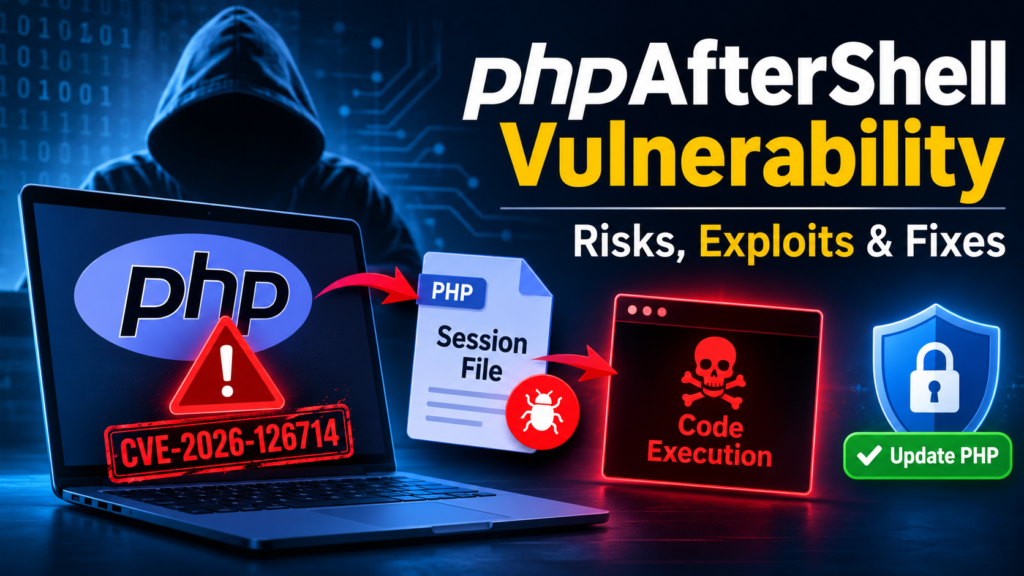
This announcement has come just after the discovery of the PHP2Shell vulnerabilities in October 2026, showing the dangers that can be posed by the lack of patching PHP technology.
This announcement is very crucial for companies relying on PHP apps.
1. What Has PHP Announced?
On November 18, 2026, the security team at PHP announced a pre-announcement of security releases that were planned for release on November 19.
These releases are part of the standard four-week release schedule of PHP and will fix various security vulnerabilities in all supported PHP releases.
The release window is scheduled between 2:00 PM and 2:30 PM UTC on November 19, 2026.
According to the PHP team, the highest severity level of the vulnerabilities that have been discovered is Critical. However, it is stated that the vulnerabilities that fall under this category should meet certain criteria, like non-standard configuration and installation.
At the time of announcing the vulnerabilities, PHP had not released all information concerning the vulnerabilities and patches, including the list of the vulnerabilities and versions in which the vulnerabilities can be found.
It is strongly advised by the development team to get ready for the updates and install them right away.
2. CVE-2026-115560: A Remote Code Execution Vulnerability
Vulnerability CVE-2026-115560 is one of the problems that was supposed to be fixed in the November 19 patch release.
The vulnerability has to do with the use of PHP's session upload progress and allows remote code execution in certain configurations.
Session upload progress is a PHP tool that allows applications to track the progress of file uploads. While it is useful for some applications, its interaction with PHP session serialization poses a security risk if used in a certain configuration.
As per the technical information available, the following two factors must be present for the application to be at risk:
- The application configures
session.serialize_handlerasphp_binaryorphp_serializeand then switches the handler tophpusingini_set()before callingsession_start(). - Session upload progress is enabled, which is the default PHP configuration.
This makes up a vulnerability that can be exploited by the attacker based on the required conditions.
It should be known, however, that not all installations of PHP are vulnerable to this exploit. This depends on how the application has been configured regarding the session and file uploads.
The PHP team has recommended disabling session upload progress as a temporary workaround until security updates are available.
3. Why Is This Vulnerability a Serious Concern?
RCE Vulnerabilities are some of the most dangerous security vulnerabilities because they give attackers chances to execute malicious code in a targeted system.
When such a vulnerability is exploited, the following opportunities may present themselves to the attackers:
- Execute unauthorized commands on a server.
- Access sensitive application information.
- Steal confidential user data.
- Install malicious scripts or backdoors.
- Modify website files and application settings.
- Use compromised servers to launch additional attacks.
For online businesses, exploitation of an RCE vulnerability in a PHP server can result in various impacts including those that relate to availability, information, and operations.
Although CVE-2026-115560 demands certain configurations, it cannot be overlooked. Applications which have special session handling configurations must be scrutinized carefully.
4. Temporary Mitigation Recommended by PHP
Until the November 19 patch, developers and system administrators could consider implementing the suggested mitigation.
For PHP, the suggested mitigation is to disable the session upload progress by using the following configuration setting:
session.upload_progress.enabled=0It will disable the session upload progress feature and mitigate the vulnerability exposure.
However, it is important for administrators to implement the above configuration at the right level of configuration.
Some of the suggested levels for implementation are:
- The main
php.iniconfiguration file. - A PHP-FPM pool configuration.
- The relevant server configuration.
The setting needs to be applied before the request gets parsed. Using ini_set() or an FPM .user.ini file to change the setting is not an adequate mitigation for the problem.
Following the configuration changes, administrators need to restart all PHP processes to make sure that the new setting is applied.
It is also essential to examine the application code for any runtime call that changes the session serializer handler to php.
PHP has suggested that if applications do not perform such runtime handler changes, then they may continue using session upload progress.
This gives an interim mitigation solution until security patches are made available.
5. Connection With the Earlier PHP2Shell Vulnerabilities
The most recent security warning is just after yet another significant PHP security issue with two vulnerabilities that were termed as PHP2Shell.
In October 2026, security researchers identified two vulnerabilities:
- CVE-2026-109618
- CVE-2026-109619
These two vulnerabilities would enable unauthenticated users to run any arbitrary code with the help of HTTP requests.
There was a security risk for all those PHP versions that had the vulnerability.
Two security patches were made available by PHP on October 21, 2026, for the two vulnerabilities.
The patched versions included:
| PHP Branch | Security Update |
|---|---|
| PHP 8.5 | 8.5.12 |
| PHP 8.4 | 8.4.27 |
| PHP 8.3 | 8.3.36 |
| PHP 8.2 | 8.2.35 |
It was highly recommended for users using the old versions to upgrade.
The vulnerability in the PHP2Shell also served as an example of how a vulnerability in the widely used programming language affects web sites, hosting environment, and business application.
This November security release has shown the need to update the PHP environment and monitor any new vulnerabilities.
It should be noted that the October vulnerabilities in PHP2Shell and the recently released November security vulnerabilities are different issues.
6. Which Systems Could Be Affected?
Since PHP is used extensively in modern web development, security updates are quite significant for organizations running PHP-powered applications.
Examples of some of the platforms and technologies using PHP include:
WordPress: A popular content management system. Most of the business websites, blogs, and online shops use PHP.
Laravel: A popular PHP framework utilized to develop web applications, APIs, and business platforms.
Drupal: An open-source content management system used by organizations to run their websites and digital platforms.
Magento: An e-commerce platform powered by PHP.
Custom PHP Applications: Organizations often create specialized applications that use PHP to support customer portals, payment applications, dashboards, and business applications.
In case a vulnerable PHP execution environment exists, such applications could be affected in case certain prerequisites exist.
This implies that developers need to check not only the version of PHP on the website but also in the server environment and application settings.
7. What Should Developers and Website Administrators Do?
It is advisable to take preventative measures to prevent exploitation.
Here are some important security recommendations.
Step 1: Check Your Current PHP Version
Begin by determining the PHP version currently being used by your server.
You can check the version using the following command:
php -vThis displays the PHP version installed in your command-line environment.
Do not forget that the PHP version used via the command line might be different from the one your website is using.
Step 2: Review PHP Configuration
Examine the session-related configuration settings, particularly:
session.serialize_handler
session.upload_progress.enabled
Check whether your application changes the session serialization handler during runtime.
Step 3: Apply the Temporary Mitigation
Until the official updates are available, consider disabling session upload progress:
session.upload_progress.enabled=0Restart the PHP workers after applying the configuration.
Step 4: Monitor Official PHP Security Advisories
Continue to visit the official PHP website for the most recent updates regarding security bulletins, versions affected, and patches.
Do not base your decisions completely on external information on whether your system has been patched.
Step 5: Install the Security Updates
When the security updates of November 19 are out, pick the right patched version according to your PHP branch.
Acquire the updates from authorized sources of PHP or through your hosting provider’s package management system.
Step 6: Restart PHP Services and Verify
Upon updating PHP, restart the relevant services like PHP-FPM or Apache if required.
Make sure that your site is using the new PHP version by verifying application logs for any errors.
Step 7: Review Application Security
Updating PHP is key, yet application-level security can’t be overlooked.
Session handling, file uploads, access control, dependency management, and server setup all require regular review by developers.
8. Why Regular PHP Security Updates Matter
Cyber-attacks can take advantage of software vulnerabilities. Threat actors are always looking out for old software, open services, and vulnerable servers.
Updates to PHP can assist in fixing those problems before they can be exploited further.
Delaying security patches can expose organizations to several risks:
- Website compromise and unauthorized access.
- Remote code execution attacks.
- Data theft and privacy violations.
- Malware infections and backdoor installation.
- Service interruptions and operational disruption.
There is a need for organizations to have a consistent patch management policy rather than reacting to vulnerabilities as they arise.
Vulnerability management requires consistent software updates, configuration checks, security assessments, and monitoring.
9. What Happens Next?
The security team of PHP has fixed the schedule of release of PHP on November 19 from 2:00 to 2:30 PM UTC.
The technical details, vulnerabilities, and version numbers of the fixes are supposed to be made available at the time of releases.
Developers and system administrators need to be aware of the news and make preparations for the application of patches immediately.
This release is also associated with the release of the next major version of PHP, that is, 8.6.0.
However, administrators need to differentiate between the new PHP version and the security fixes. The production environment should always rely on the stable versions of PHP.
Conclusion
The most recent security bulletin from PHP emphasizes the need to secure the server side application against vulnerabilities.
While the critical vulnerabilities supposedly need non-default or unusual configuration settings, the consequences of a successful exploitation warrant giving the security bulletin enough attention.
The inclusion of CVE-2026-115560 regarding PHP session upload progress and serialization is expected, making it essential to review the application configuration.
In addition to following the mitigation measures suggested by PHP and keeping track of the PHP security advisories, the organization needs to install the November 19 security patches.
Proactive approaches with regards to security updates, configuration, and vulnerability management are crucial for securing PHP-powered websites and applications.
Frequently Asked Questions (FAQs)
1. What security issues has PHP announced in November 2026?
Security updates to address vulnerabilities impacting all supported versions of PHP have been scheduled. Critical is the maximum impact rating for any vulnerability, and CVE-2026-115560 is likely to be included in the list of vulnerabilities to be resolved.
2. When will PHP release the security patches?
The PHP security team has scheduled the updates for November 19, 2026, between 2:00 PM and 2:30 PM UTC.
3. What is CVE-2026-115560?
CVE-2026-115560 is a remote code execution vulnerability in PHP session upload progress. This exploit needs a particular configuration of session serialization and runtime handler.
4. Are all PHP installations vulnerable?
No. While the patches for security fixes apply to all versions of PHP, the critical vulnerabilities need non-default configurations and setup. CVE-2026-115560 requires special configurations too.
5. How can developers temporarily protect their PHP applications?
Developers can temporarily mitigate the known session upload progress issue by setting session.upload_progress.enabled=0 in the appropriate PHP configuration and restarting PHP workers.
6. What were the PHP2Shell vulnerabilities?
PHP2Shell vulnerability comprises two critical vulnerabilities of PHP, CVE-2026-109618 and CVE-2026-109619, which have been reported in October 2026. It can lead to unauthenticated remote code execution via specially crafted HTTP requests.
7. Should website owners update PHP immediately?
Yes. It is important for web owners to keep themselves informed about official security updates and update their version of PHP as soon as possible to prevent any vulnerabilities.
8. Where can users find official PHP security updates?
Official information about security notices, versions, and other technical details is available on the PHP website located at https://www.php.net/.