
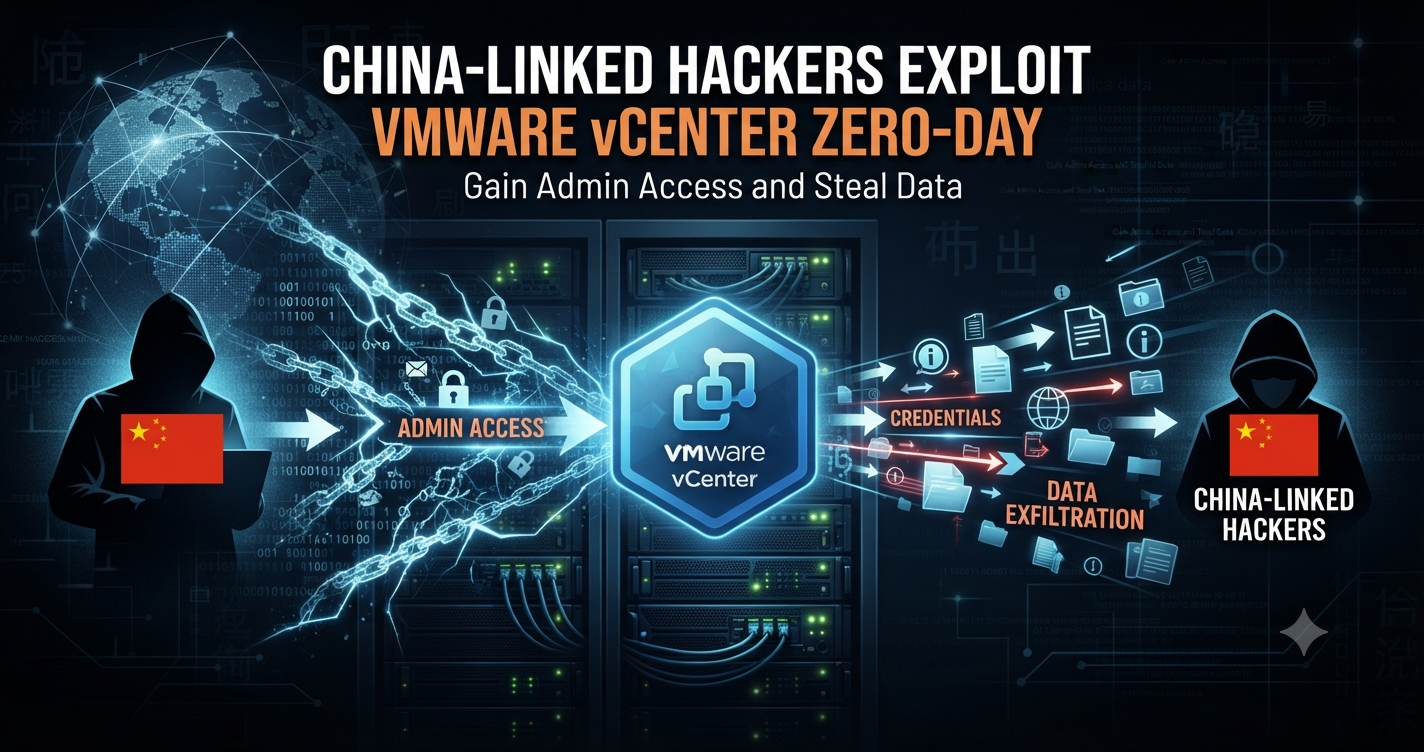
An important incident relating to the field of cybersecurity shows how the hacking group linked to China managed to take advantage of the serious VMware vCenter vulnerability and obtain administrator privileges and steal sensitive information.
According to the reports, the described vulnerability has the designation CVE-2026-123890. This vulnerability is associated with the VMware vCenter Server and has a CVSS score of 9.8. The vulnerability makes it possible for any attacker to establish an admin session without providing credentials by simply having network access.
It has been established that the exploit has been performed by the cyber espionage group, which is linked to China and is known as Armory Castle. It has been found that this group took advantage of the vulnerability in VMware vCenter in September 2026, which is more than two months before the bug was made public and fixed.
The described case is alarming because of the crucial role that is played by VMware vCenter in controlling virtualized environments.
As per GTIG and Mandiant, the attackers utilized a specialized tool known as BONESAW to exploit the vulnerability, steal the sensitive data from databases, hijack the authentication services and create unauthorized administrator accounts.
This article gives a detailed explanation of the VMware vCenter vulnerability, the mechanism of the attack, the affected versions, the techniques used by Armory Castle and the way to protect your infrastructure from the threat.
What Is the VMware vCenter Vulnerability?
The VMware vCenter security threat is a very serious authentication bypass vulnerability that exists in VMware vCenter Server.
This vulnerability is identified by the name CVE-2026-123890, and its CVSS severity score stands at 9.8 out of 10.
The threat impacts VMware Directory Service, better known as vmdir, and it is related to the directory-based authentication and identity management processes on VMware vSphere.
From a technical perspective, this vulnerability relates to the Secure Remote Password (SRP-6a) authentication. The problem is explained by researchers to be related to leaking an SRP session key via DCE/RPC.
An attacker will then be able to evade the usual authentication mechanism and authenticate itself as:
administrator@vsphere.local
This account is an administrative account within the vSphere environment.
The VMware vCenter vulnerability shows how a problem with the authentication service opens up the enterprise infrastructure to attacks.
Key Details About CVE-2026-123890
These are the key technical aspects of the VMware vCenter security hole:
| Detail | Information |
|---|---|
| Vulnerability ID | CVE-2026-123890 |
| Affected Product | VMware vCenter Server |
| Vulnerable Component | VMware Directory Service (vmdir) |
| Vulnerability Type | Authentication Bypass |
| CVSS Score | 9.8 |
| Severity | Critical |
| Attack Requirement | Network access; no authentication required |
| Exploited By | Armory Castle (formerly UNC5221) |
| First Observed Exploitation | Early September 2026 |
| Public Disclosure | November 19, 2026 |
| Security Updates | November 19, 2026 |
Vulnerability of the VMware vCenter was exploited by attackers before the patch for it was released by Broadcom. This shows that there was a zero-day attack on this vulnerability.
Who Is Armory Castle?
Armory Castle is an alleged China-related cyber espionage group that was formerly referred to as UNC5221.
The group has been linked with advanced cyber attacks on enterprise security systems and network infrastructures.
According to the reports of Google Threat Intelligence Group and Mandiant, Armory Castle has shown capabilities to use vulnerabilities in enterprise security systems and create specific tools for attacking targets.
This group’s recent attack on VMware vCenter system has revealed multiple dangerous capabilities:
- Taking advantage of new security flaws discovered by the group.
- Securing unauthorized administrator access.
- Accessing sensitive authentication and database data.
- Generating unauthorized Single Sign-On (SSO) accounts.
- Deploying specialized malware for maintaining access.
- Targeting enterprise virtualization infrastructure.
This is clear from the fact that the group has used zero-day exploits and tailored malware for its operations.
How Did Hackers Exploit the VMware vCenter Vulnerability?
Google and Mandiant have found that Armory Castle used the CVE-2026-123890 vulnerability in early September 2026 on a VMware vCenter server located in an already compromised network.
The attack involved several stages.
1. Exploiting the Authentication Bypass
Exploiting the VMware vCenter flaw made it possible for the attacker to extract the SRP authentication session key.
This is because there is predictability in UUIDv1 timestamp generation in the SRP authentication protocol, which allows hackers to extract the session key without needing the password of the legitimate user.
This made it possible for the hacker to bypass the authentication process and create an admin session.
2. Using BONESAW to Automate the Attack
The perpetrators employed a unique utility developed using Go programming language, which was called BONESAW.
The function of the tool was to exploit CVE-2026-123890 and carry out various post-exploitation tasks on the VMware vCenter.
Its features included the following:
- Database extraction of vCenter Directory Service.
- Manipulation of SAML authentication methods.
- Unlawful creation of SSO administrators.
- Skipped authentication process automatically.
The tool highlights how an attacker could use the VMware vCenter vulnerability to exploit organizations on a repetitive basis.
3. Stealing Sensitive Database Information
Once the attackers gained access to the administrator’s account, they leveraged the vCenter Directory Service interface to access the data.mdb database.
The information stored in this database is valuable as it may provide details about the organization’s authentication and identity architecture.
Knowledge of such information may pose further threats to the enterprise.
4. Hijacking the SAML Security Token Service
The other crucial phase includes compromising the SAML Security Token Service (STS).
SAML is extensively used for purposes of authentication and Single Sign-On.
Through compromising STS, hackers could get a chance to tamper with the authentication process and create access vulnerabilities within the VMware system.
5. Creating Unauthorized Administrator Accounts
The attackers also utilized the BONESAW tool to create SSO administrator accounts.
This would provide the attackers with another means of accessing the compromised vCenter infrastructure, thereby making it harder for the administrator to detect any malicious activity.
The above attack demonstrates how a single weakness in the VMware vCenter software can pave the way for various levels of compromise of enterprise infrastructure.
Which VMware Products and Versions Are Affected?
VMware vCenter Vulnerability exists in a number of VMware products, which have VMware vCenter Server components.
Broadcom issued security patches on November 19, 2026.
The below versions have the patch:
| Product | Fixed Version |
|---|---|
| VMware Cloud Foundation 9.1.x | 9.1.1.0200 |
| VMware Cloud Foundation 9.0.x | 9.0.2.0200 |
| VMware vSphere Foundation 9.1.x | 9.1.1.0200 |
| VMware vSphere Foundation 9.0.x | 9.0.2.0200 |
| VMware vCenter Server 8.0 | 8.0 U3m |
| VMware Cloud Foundation 5.x | 5.2.5 |
| VMware Telco Cloud Platform | Corresponding fixed vCenter 8.0 U3m build |
| VMware Telco Cloud Infrastructure | Corresponding fixed vCenter 8.0 U3m build |
VMware vCenter 7.0 customers who have extended support should reach out to Broadcom Support regarding the relevant security patch.
Earlier versions, such as vSphere 6.5 and 6.7, should be considered vulnerable as per Broadcom’s advisory.
Also, administrators should keep in mind that this vulnerability is irrespective of whether Enhanced Linked Mode is enabled or not.
Crucially, Broadcom has clarified that the ESXi itself is not affected by this vulnerability.
What Are the Security Risks of the VMware vCenter Vulnerability?
A number of dangers result from the VMware vCenter vulnerability.
1. Unauthorized Administrator Access
The greatest threat would be that of authentication bypass, which results in administrative access.
Attackers can take control of critical vSphere management activities even without knowing the real credentials of the administrator.
2. Sensitive Data Theft
A vulnerability in the vCenter Directory Services Database might lead to disclosure of valuable information related to enterprises.
Attackers might plan their next attack based on this information.
3. Identity and Authentication Compromise
Manipulation of SAML STS and unauthorized creation of SSO accounts can weaken authentication systems used in enterprises.
It becomes hard for security personnel to differentiate normal actions of administrators from the actions done by attackers.
4. Enterprise Infrastructure Compromise
VMware vCenter is used to control and manage the virtualized environment, including ESXi hosts and virtual machines.
If compromised, it gives attackers an important foothold to conduct reconnaissance on enterprise environments.
5. Long-Term Cyber Espionage
Because Armory Castle has been linked to cyber espionage, it can provide access that can be used for intelligence gathering and gaining access to the organization.
The potential effect would depend on the privileges of the hacker, the connections of the system to vCenter, and the controls that exist.
How Can Organizations Protect Against the VMware vCenter Vulnerability?
Organizations using VMware vCenter should view CVE-2026-123890 as a critical vulnerability that needs immediate attention.
Broadcom has issued patches for vulnerable versions, but there is no official workaround mentioned from the vendor. Remediation is strongly recommended.
Here are some security recommendations.
1. Apply the Latest VMware Security Patches
The key point is the updating of vulnerable VMware products to the patched versions from Broadcom.
It is necessary to check the current version of vCenter and apply the security patch.
There is no need to postpone the updating process since the vulnerability of VMware vCenter has been already used in practice.
2. Restrict Network Access to vCenter
Exposure of VMware vCenter to any unauthorized networks and even to the Internet should be avoided at all costs.
Access to the management interface should be limited and restricted to authorized administrative systems.
3. Monitor Unauthorized Administrator Accounts
Monitor accounts in VMware SSO and administrative permissions.
Check for strange accounts and log-in events and any odd modifications made to directory services.
4. Monitor Network Traffic and Logs
Security staff must keep an eye on any strange connection attempts to VMware management services.
Focus on:
- Unexpected DCE/RPC connections.
- Suspicious authentication attempts.
- Unusual administrator account creation.
- Unexpected database access.
- Suspicious outbound network connections.
Centralized logging and SIEM can be beneficial for security professionals to recognize suspicious behavior.
5. Strengthen VMware Infrastructure Security
It is important to adhere to the guidelines on VMware security hardening.
Such security practices should involve limiting administrative access, implementing least-privilege access policies, conducting network segmentation, and tracking administrative activities.
6. Investigate Potential Compromise
Companies who had been using susceptible software during the exploit window should not think that applying patches solves their problem.
There is a need to look into:
- Unauthorized SSO administrator accounts.
- Suspicious SAML token activity.
- Unexpected changes to vCenter configuration.
- Unusual database extraction activity.
- Unknown processes or malware.
- Unexpected SSH access and outbound connections.
In case of a breach, organizations must undertake an incident response approach and seek the help of experts.
7. Implement Network-Level Firewall Controls
Google and Mandiant both advise the need for better protection on the network level for VMware Cloud Foundation appliances.
Granular firewall rules, default deny policies, and logging can be considered by organizations.
This will lower the opportunities for attackers in case there is any vulnerability.
Why Is the VMware vCenter Vulnerability Important for Cybersecurity Professionals?
VMware vCenter vulnerability points to the increasing need to secure virtualization infrastructure.
For ethical hackers, penetration testers, and cybersecurity professionals, this incident provides several important lessons.
Authentication security: The vulnerability illustrates how flaws in the authentication processes may expose privileged enterprise accounts to attacks.
Zero-day exploitation: The attackers were able to exploit this vulnerability before an official fix could be rolled out, stressing the need for security monitoring.
Identity and directory security: Breaches of the directory service and SSO technology pose chances for broader enterprise access.
Malware analysis: BONESAW shows how attackers use their customized exploits and automation tools during post-exploitation phase of attacks..
Infrastructure security: Virtualization systems are critical infrastructures due to the role they play in managing key enterprise functions.
IT security experts need to conduct security assessments of virtualization management tools, authentication systems and admin consoles.
Conclusion
The Armory Castle attacks linked to China pose a significant danger to enterprise virtualization platforms due to their use of zero-day vulnerabilities.
CVE-2026-123890 is a VMware vCenter vulnerability that enables attackers to bypass authentication processes and achieve elevated privileges through VMware Directory Service.
By deploying the targeted BONESAW attack, attackers can steal database credentials, perform SAML authentication, and create privileged accounts for administrators.
This attack is of critical nature due to its CVSS rating of 9.8, and it has been exploited before being publicly disclosed.
Firms need to ensure that they install the latest Broadcom security patches, limit access to vCenter administrative tools, monitor any suspicious activity from administrators, and analyze systems which might have been attacked.
The attack highlights an important lesson for cybersecurity, that securing enterprise infrastructure is not enough relying on perimeter defenses. Effective authentication, constant monitoring, proper network segregation, and vulnerability management are necessary for protection against modern cyber attacks.
Frequently Asked Questions (FAQs)
1. What is the VMware vCenter vulnerability CVE-2026-123890?
Vulnerability CVE-2026-123890 for the VMware vCenter software is an important authentication bypass vulnerability that exists within the VMware vCenter Server. This vulnerability enables attackers with network access to take advantage of the vulnerability within the VMware Directory Service and gain administrator access rights.
2. Who is exploiting the VMware vCenter vulnerability?
Armory Castle, formerly known as UNC5222, is a Chinese-linked espionage group believed to have exploited the aforementioned vulnerability in the VMware vCenter software in September 2026.
3. What is the severity of the VMware vCenter vulnerability?
The vulnerability has a CVSS score of 9.8 out of 10, making it a critical security issue.
4. What is the BONESAW malware tool?
BONESAW is a Golang tool designed specifically for the exploitation of the VMware vCenter vulnerability. This tool is capable of database extraction, SAML authentication manipulation, and creation of unauthorized SSO administrator accounts.
5. Which VMware versions are affected by the VMware vCenter vulnerability?
This vulnerability impacts VMware vCenter 8.0, 9.0, and 9.1, as well as associated products such as VMware Cloud Foundation, vSphere Foundation, and Telco Cloud. Unsupported versions are also subject to being vulnerable.
6. How can organizations protect against CVE-2026-123890?
These organizations are advised to deploy the latest security patches from Broadcom, limit access to vCenter in their networks, monitor their admin users, and analyze any suspicious events.
7. Is VMware ESXi affected by the VMware vCenter vulnerability?
No. Broadcom has specified that the ESXi product itself is not vulnerable.