
Introduction
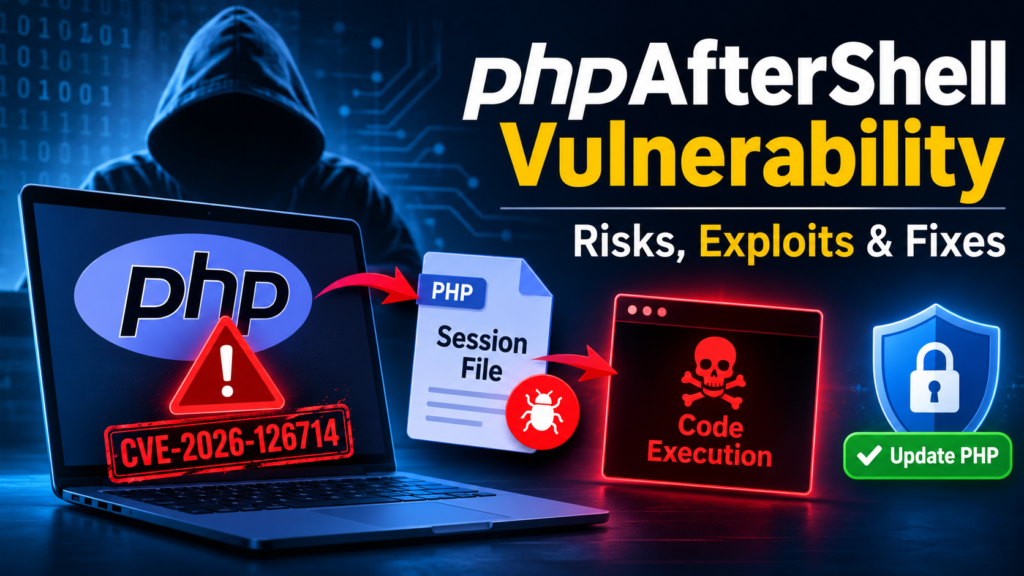
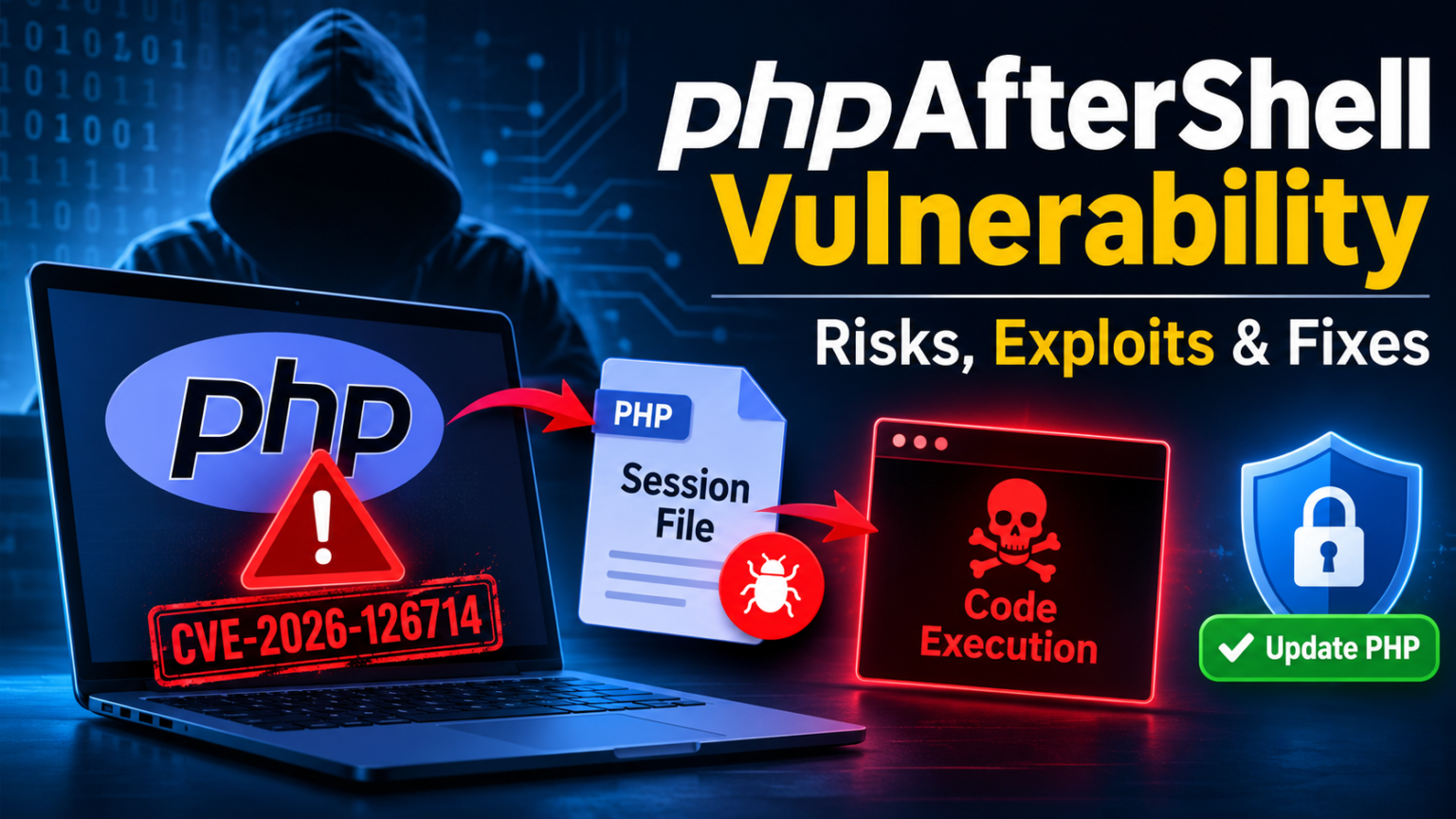
There is a recently discovered PHP vulnerability referred to as phpAfterShell, which is causing fear among website owners, developers, and cybersecurity experts. The threat involves the way PHP handles sessions and could result in the ability of hackers to control the data used during sessions, and even run their code on the server.
The discovered vulnerability has been assigned CVE-2026-126714 and has been rated 9.2 on the 10-point scale by PHP maintainers. Researchers at Depthfirst discovered the flaw and informed the PHP developers, who provided patches on November 19, 2026.
The vulnerability is especially scary since it affects the way PHP saves and opens sessions. In some cases, attackers could modify the partial data in the session to get PHP to load the objects created by them. Together with an application vulnerability, this could lead to remote code execution.
Here in the article, we discuss the phpAfterShell vulnerability in detail and explain its cause, which PHP versions are vulnerable, and what developers can do to safeguard their systems from exploitation.
What Is the phpAfterShell Vulnerability?
The phpAfterShell vulnerability is a severe vulnerability that targets PHP's built-in file-based session management system.
PHP uses session management techniques to preserve information on different web requests by users. For instance, after a user logs into a website, PHP keeps track of their login and account details using session information.
By default, PHP saves this session information in session files on the server; however, this is where the vulnerability of phpAfterShell kicks in.
However, should the write process get interrupted at the correct time, then the created file may be able to incorporate a mixture of data that has been written recently, along with the existing data. This situation can possibly be exploited by attackers to get PHP treat the old data as a new object.
During another load, PHP can recreate the attacker-defined object.
The issue gets even more problematic in situations where the application has other vulnerabilities that will allow the object to perform unauthorized actions. Under some conditions, such an exploit can allow for arbitrary code execution.
Based on the security advisories, the vulnerability is mainly applicable to PHP installations that use the default file-based session handler.
Key Details About CVE-2026-126714
Here are the important technical details of the phpAfterShell vulnerability:
- Vulnerability Name: phpAfterShell
- CVE ID: CVE-2026-126714
- Affected Technology: PHP
- Affected Component: File-based session storage
- Severity: Critical
- CVSS Score: 9.2 (CVSS 4.0)
- Discovered By: Depthfirst security researchers
- Disclosure Date: November 19, 2026
- Primary Risk: Session manipulation and potential remote code execution
It shows how vulnerability in something that looks like an ordinary application feature can have a very negative impact on security.
How Does the phpAfterShell Attack Work?
In order to fully understand phpAfterShell, it is essential to understand the way PHP uses sessions.
Sessions in PHP contain user information in order for programs to identify users over several requests. Whenever the website invokes the session_start() method, PHP loads the relevant session file and initializes all its contents.
The issue arises when PHP writes user session information into a file but cannot finish the process due to some reason.
The exploit may be analyzed through the following stages.
1. PHP Stores Session Information
During user interaction with a website implemented via PHP, all necessary data is stored within the session files.
Session files consist of session variables encoded in a serialized PHP way. Serialization is a process that allows storing information about the data along with its length to help PHP restore data after deserialization.
2. An Attacker Targets Session Updates
The scientists found the potential attack vector that exploits PHP upload progress functionality.
The upload progress allows PHP to track the progress of file uploads in the user's session. If the upload progress is enabled, then during the multipart upload PHP will be able to change session variables even before the application's code.
3. The Session Write Gets Interrupted
The process of PHP updates involves locking files in use. File locking does not assure that an unfinished write can be undone.
In case the PHP worker process terminates unexpectedly during this process, there is a possibility that the session file will have the beginning of the new data and the end of the old data.
This inconsistency in the session file poses a problem.
4. PHP May Interpret the Data Differently
Through manipulating the serialized data structure, an attacker could make the existing data be treated as another session entry.
This might include an object that the attacker hopes to have reconstructed by PHP.
The next time session_start() is called, it will retrieve and recreate the tampered session data and the object.
5. Additional Weaknesses Could Enable Code Execution
The mere fact of loading of a hostile object doesn’t necessarily imply that arbitrary code will be executed.
In order to make code execution possible, the attacker should exploit another flaw, either a gadget chain of appropriate PHP object injection inside the application or a vulnerability in some other component of the system.
The gadget chain implies that the attacker is exploiting certain existing operations of the application, which are triggered by means of specific objects.
The researchers have also shown how another method can be applied with the help of yet another PHP memory corruption flaw.
Which PHP Versions Are Affected?
The PHP developers made patches available for the phpAfterShell vulnerability on November 19, 2026.
The following PHP branches and versions require attention:
| PHP Branch | Affected Versions | Fixed Version |
|---|---|---|
| PHP 8.2 | Earlier than 8.2.36 | 8.2.36 |
| PHP 8.3 | Earlier than 8.3.37 | 8.3.37 |
| PHP 8.4 | Earlier than 8.4.28 | 8.4.28 |
| PHP 8.5 | Earlier than 8.5.13 | 8.5.13 |
| PHP 8.6 | Earlier releases | 8.6.0 |
PHP 8.6.0 also includes the security fix.
The administrators using older PHP versions need to update their software to supported ones.
Furthermore, it needs to be mentioned that PHP 8.1 and below are end-of-life. While some security patches in PHP 7.4, 8.0, and 8.1 official branches do not have this bug, some older versions might be exposed to it.
What Are the Potential Security Risks?
The PHP after shell bug poses several dangers to websites and web applications.
1. Remote Code Execution
The biggest threat that arises due to such a vulnerability is that of remote code execution. In case attackers manage to exploit the vulnerability and find an additional weakness to leverage, they might end up executing arbitrary commands or code on the server.
2. Session Hijacking and Manipulation
Attackers would be able to manipulate valuable session values through this vulnerability.
This includes the security-related session values like authentication and user permissions, among others.
3. Unauthorized Account Access
In the case that the session information relevant to authentication is altered and the application does not authenticate it properly, attacks can obtain access to the user accounts or other privileged areas.
4. Cross-Site Request Forgery Protection Risks
Many PHP applications use CSRF tokens as session variables.
An attack might then alter these values.
5. Server and Application Compromise
If successful, this would allow the attacker to gain access to sensitive information from the application or manipulate the website, or even gain additional access.
The extent of harm caused will depend on various factors like the application’s architecture, server setup, permissions, and other possible vulnerabilities present.
How Can Developers and Website Owners Protect Their Systems?
The developers behind PHP have provided patches for phpAfterShell, which companies must consider installing.
Some of the security recommendations are as follows.
1. Update PHP Immediately
The first and foremost measure is to move to the stable PHP version:
- PHP 8.2.36
- PHP 8.3.37
- PHP 8.4.28
- PHP 8.5.13
- PHP 8.6.0
Make sure the PHP version processing the web requests has been upgraded.
2. Disable Upload Progress Temporarily If Necessary
In case this cannot be done immediately and in case upload progress is not required by your application, you can temporarily turn off the feature in your PHP configuration:
session.upload_progress.enabled = 0
Restart the PHP workers after making the change.
However, this is only a temporary fix to the problem.
3. Review Session Storage Configuration
Organizations must review the session management of their PHP applications.
Redis-based session handlers, database session handlers, or other non-specific storage solutions are not impacted by this issue of the file-handler in phpAfterShell. Nonetheless, organizations must review how their session handler copes with an update interruption.
4. Limit Untrusted Data in Sessions
Do not add any user-controlled data directly to the session variables.
Make sure that user input is properly sanitized and validated prior to its use in your application logic.
5. Rebuild and Redeploy Containers
Organizations that have Docker or any other container-based infrastructure should re-create the image with the updated PHP version.
Updating the host itself doesn't guarantee the upgrade of the PHP version on the working containers.
6. Monitor Server Activity
Check application logs, PHP error messages, server processes, and any suspicious session-related behavior.
IT security personnel should investigate any suspicious termination of workers, upload attempts, and changes in application behavior.
7. Verify the Security Patch
Once you have upgraded to PHP, verify that the new version of PHP is actually being used by the server to fulfill website requests.
In some Linux distributions, the security updates to PHP may be installed while still retaining the same version number of PHP in the upstream code base.
phpAfterShell vs PHP2Shell: What Is the Difference?
phpAfterShell has drawn even more interest due to its relationship with the previous security issues in PHP called PHP2Shell.
The problems with PHP2Shell have been fixed with security patches that came out on October 21, 2026.
But, these security patches did not fix the underlying file writing problem that created the phpAfterShell.
These previous security patches limited the classes that were allowed to be used when there was a file uploading process. Even though this fixed the attack vector, the session file could still be corrupted during writing.
The security patches for phpAfterShell solve this problem by changing the file writing process of PHP.
This is significant because installing the security patches from October 21 would not be enough to prevent a phpAfterShell attack. The new security patches must be installed on November 19.
Why Is phpAfterShell Important for Cybersecurity Professionals?
phpAfterShell emphasizes the need for deeper understanding of the vulnerabilities, other than just their technical description.
The case is important for ethical hackers and pen testers because it illustrates how session management, serialized objects, file handling, and the application logic can be combined together to create security holes.
Security experts must focus on:
- PHP session management and object serialization.
- Object Injection Vulnerability.
- Failure of file handling and writes.
- Possible Remote Code Execution paths.
- Application security configurations.
- Input Validation and Secure Coding.
Organizations must also consider session management tests when conducting security audits.
The knowledge about how such vulnerabilities occur is useful for developers in developing safer software and will allow security professionals to spot weaknesses before they can be used by malicious users.
Conclusion
The phpAfterShell vulnerability (CVE-2026-126714) demonstrates the potential dangers associated with the inadequacy of PHP’s default session storage methods.
The criticality of the bug, as expressed in its CVSS 4.0 base score of 9.2, warrants quick action on the part of developers, hosting providers, and system administrators. Although remote code execution is not feasible without additional parameters, manipulating session data alone may be sufficient to compromise applications.
Users are advised to install the patched versions of PHP and check their session storage settings.
Above all, administrators should avoid the misconception that their earlier security patches against PHP2Shell provide protection against phpAfterShell. Upgrading to the new version is still the preferred course of action.
It goes without saying that regular software updates, proper coding, and routine vulnerability assessment are important prerequisites to securing websites and digital infrastructure.
Frequently Asked Questions (FAQs)
1. What is phpAfterShell?
phpAfterShell is a dangerous PHP vulnerability associated with the file-based session storage method that is used by default in PHP.
2. What is the CVE number for phpAfterShell?
The vulnerability is tracked as CVE-2026-126714 and has a CVSS 4.0 severity score of 9.2.
3. Which PHP versions are affected by phpAfterShell?
PHP versions earlier than 8.2.36, 8.3.37, 8.4.28, and 8.5.13 in their respective branches are affected. PHP 8.6.0 includes the fix.
4. Can phpAfterShell lead to remote code execution?
Yes. In some cases, it is possible for hackers to change the PHP session data and execute their code on the server, leveraging the object injection vulnerability and another one in the application.
5. How can developers protect against phpAfterShell?
There are several steps developers can take to protect themselves from phpAfterShell attacks.
6. Does disabling PHP upload progress fix phpAfterShell?
Absolutely not. Although turning off the setting session.upload_progress.enabled will stop the attack shown from working, it will not fix the root problem with the session storage. The patch needs to be installed.